
From RAG to Memory Systems — Part 5: Running It in Production
Exact vs semantic retrieval, the AgentCore Memory SDK, Bedrock prompt-caching economics, full observability, real cost numbers, multi-agent memory sharing, evaluation, and the five-gate production checklist.
In This Part
- Exact-match and semantic retrieval solve different problems — using the wrong one for a query type is a bug, not a modelling choice.
- AgentCore Memory SDK, Bedrock prompt-caching economics, and end-to-end observability (X-Ray, CloudWatch, Athena) close the loop operationally.
- Real cost numbers: roughly $0.0037 per turn at 10k turns/day, with clear levers for each cost driver.
- Multi-agent memory sharing, an evaluation harness, and five production-readiness gates that all have to hold at once before shipping.
Table of Contents
20. Exact vs semantic retrieval
The most common mistake in memory systems is using semantic retrieval for everything. Semantic retrieval is the right tool for "find documents conceptually related to X". It is the wrong tool for "what is this user's timezone preference". Using the wrong retrieval mode for a query type is a bug, not a modelling choice.
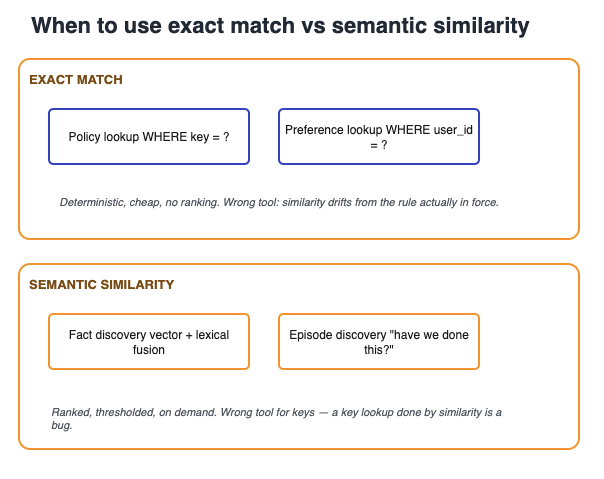
Figure 18: Retrieval mode decision matrix. Key-value lookups → exact match. Concept search → semantic. Episode recall → hybrid. The table below shows specific examples.
Here's how to choose the right retrieval mode for each query type:
| Query type | Retrieval mode | Why |
|---|---|---|
| "What is the refund policy?" | Semantic (vector) | Concept-based lookup, no exact key |
| "What is this user's timezone?" | Exact (DynamoDB) | Key-value lookup: pref_key = 'timezone' |
| "Show me past invoices for Acme Corp" | Exact + filter | Filter by customer_id = 'acme', no ranking |
| "How did we solve X last time?" | Hybrid (vector + lexical) | Episodic memory: concept + keyword match |
| "What are the approval rules?" | Exact (DynamoDB) | Policy lookup: policy_key = 'approval_threshold' |
A practical rule: if you know the key, use exact retrieval. If you're searching for a concept, use semantic retrieval.
21. AgentCore Memory SDK integration
AWS AgentCore Memory is a managed service that provides a memory API for agents. Instead of building the memory manager yourself, you can use the AgentCore SDK to handle storage, retrieval, and scope enforcement. The SDK abstracts away Aurora, DynamoDB, and S3 — you get a simple interface for create, search, and delete operations.
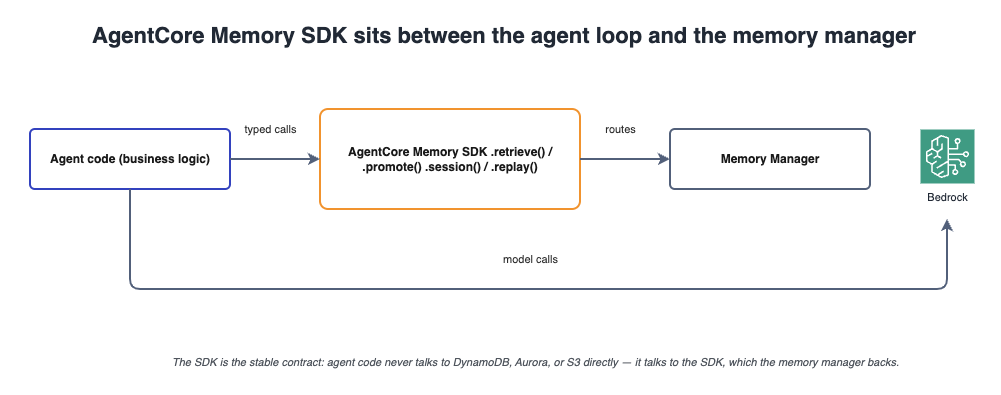
Figure 19: AgentCore Memory SDK architecture. The SDK sits between your agent code and managed storage. Scope enforcement, deduplication, and GDPR deletion are handled automatically.
Here's the basic usage pattern:
Python — AgentCore Memory SDK:

import boto3
from agentcore import MemoryClient

# Initialize AgentCore Memory client
memory_client = MemoryClient(
    region_name="eu-west-1",
    memory_id="mem-abc123"  # Created via AWS Console or CloudFormation
)

# Store a fact
memory_client.create_memory(
    session_id="session-xyz",
    memory_type="FACT",
    content="Acme Corp's production database is in eu-west-1",
    metadata={
        "subject": "customer:acme-corp",
        "predicate": "infrastructure",
        "confidence": 0.92
    },
    scope={
        "tenant_id": "tenant-abc",
        "user_id": "user-123"
    }
)

# Retrieve relevant memories
results = memory_client.search_memories(
    session_id="session-xyz",
    query="Where is Acme's database?",
    memory_types=["FACT", "EPISODE"],
    scope={
        "tenant_id": "tenant-abc",
        "user_id": "user-123"
    },
    max_results=5
)

for memory in results:
    print(f"[{memory.confidence:.2f}] {memory.content}")

# Delete user data (GDPR)
memory_client.delete_user_memories(
    tenant_id="tenant-abc",
    user_id="user-123"
)
AgentCore Memory handles the underlying Aurora, DynamoDB, and S3 infrastructure. You get:
- Managed storage and scaling
- Built-in scope enforcement (RLS)
- Automatic deduplication
- GDPR-compliant deletion
- CloudWatch metrics out of the box
Trade-off: you lose control over the exact storage layout and cannot tune the hybrid retrieval logic. For most teams this is the right trade-off — you get a production-ready memory system without operating it yourself.
22. Bedrock Prompt Caching — economics
Prompt caching reduces input token costs when the prefix of your prompt stays stable across requests. For agents with long system prompts (2000+ tokens of instructions, tool schemas, policies), caching can reduce input costs by 90% or more. The key is structuring your prompt so the stable content comes first.
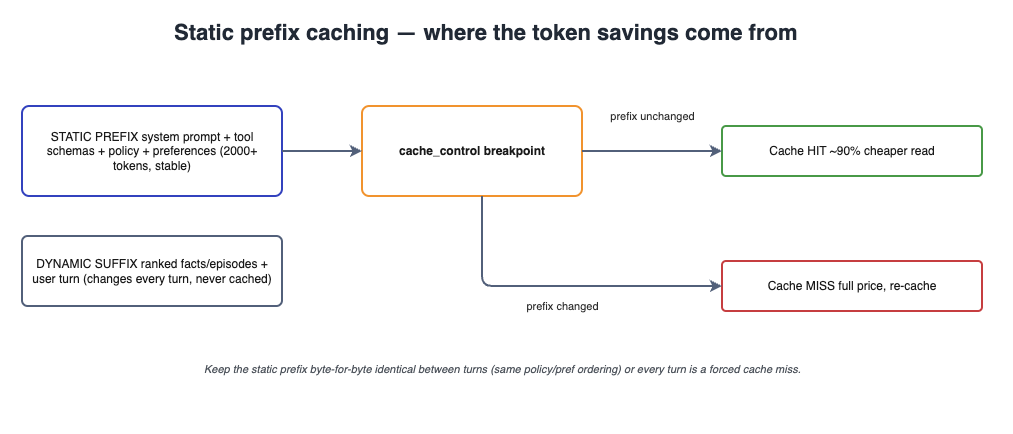
Figure 20: Bedrock prompt caching economics. The static prefix (system + policy + preferences) is cached; the dynamic suffix (facts + context + user message) changes each turn. Cache hits reduce input costs by 80-90%.
Here's the cost breakdown for different caching scenarios:
| Scenario | Input tokens | Cached tokens | Cost (Claude 3.5 Sonnet) | Savings |
|---|---|---|---|---|
| No caching | 5,000 | 0 | $0.015 | — |
| Static prefix cached (3000 tokens) | 2,000 | 3,000 | $0.003 | 80% |
| Cache miss (write new cache) | 5,000 | 0 | $0.019 (write penalty) | −27% |
Cache hit rates in production memory systems:
- Policy + preferences only: 95–98% cache hit rate. These rarely change during a session.
- Policy + preferences + top-5 facts: 60–75% cache hit rate. Facts change as the conversation progresses.
- Full conversation history: 10–20% cache hit rate. The prefix changes on every turn — caching is ineffective.
For Claude 3.5 Sonnet: if the static prefix is reused ≥2 times, caching is net positive. For agents with multi-turn conversations, this threshold is always met.
23. Observability — instrument the loop
Production memory systems need instrumentation at every step: retrieval latency, cache hit rate, gate rejection rate, token costs, and turn-level traces. Without observability, you cannot debug issues, optimize costs, or prove compliance. The diagram below shows the three observability layers: metrics, traces, and replay logs.
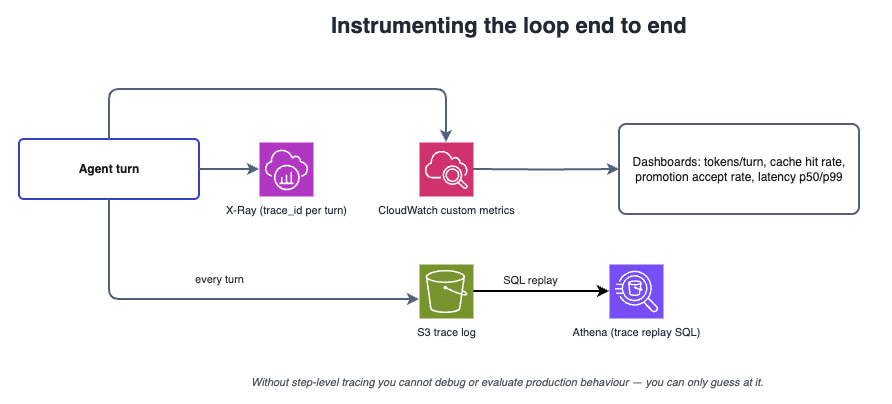
Figure 21: Observability stack. CloudWatch metrics for dashboards and alerts. X-Ray traces for debugging latency. Athena queries against S3 trace logs for replay and audit.
Here's how to instrument each component:
Python — CloudWatch custom metrics:

import boto3
from datetime import datetime

cloudwatch = boto3.client("cloudwatch")

def put_memory_metrics(tenant_id: str, metrics: dict):
    cloudwatch.put_metric_data(
        Namespace="MemorySystem",
        MetricData=[
            {
                "MetricName": "CacheHitRate",
                "Dimensions": [{"Name": "TenantId", "Value": tenant_id}],
                "Value": metrics["cache_hit_rate"],
                "Unit": "Percent",
                "Timestamp": datetime.utcnow()
            },
            {
                "MetricName": "GateRejectionRate",
                "Dimensions": [{"Name": "TenantId", "Value": tenant_id}],
                "Value": metrics["gate_rejection_rate"],
                "Unit": "Percent",
                "Timestamp": datetime.utcnow()
            },
            {
                "MetricName": "HybridRetrievalLatency",
                "Dimensions": [{"Name": "TenantId", "Value": tenant_id}],
                "Value": metrics["retrieval_latency_ms"],
                "Unit": "Milliseconds",
                "Timestamp": datetime.utcnow()
            },
            {
                "MetricName": "TokenCostPerTurn",
                "Dimensions": [{"Name": "TenantId", "Value": tenant_id}],
                "Value": metrics["token_cost_usd"],
                "Unit": "None",
                "Timestamp": datetime.utcnow()
            },
            {
                "MetricName": "PromotedFactsPerTurn",
                "Dimensions": [{"Name": "TenantId", "Value": tenant_id}],
                "Value": metrics["promoted_facts"],
                "Unit": "Count",
                "Timestamp": datetime.utcnow()
            }
        ]
    )
X-Ray distributed tracing
Python — X-Ray tracing for Bedrock calls:

from aws_xray_sdk.core import xray_recorder
from aws_xray_sdk.ext.boto_patcher import patch_all

patch_all()  # Patch boto3 clients

@xray_recorder.capture("memory_retrieval")
async def retrieve_with_tracing(query: str, tenant_id: str, user_id: str):
    xray_recorder.put_annotation("tenant_id", tenant_id)
    xray_recorder.put_metadata("query", query)

    with xray_recorder.capture("dynamo_preferences"):
        preferences = await get_preferences(tenant_id, user_id)

    with xray_recorder.capture("aurora_hybrid_search"):
        facts = await hybrid_search_facts(query, tenant_id, user_id)

    return MemoryBundle(preferences=preferences, facts=facts)
X-Ray traces show you:
- Which component is slow (Aurora? DynamoDB? Bedrock?)
- Where retries are happening
- Which tenants are seeing errors
- End-to-end latency for each turn
Athena replay from S3 trace logs
SQL — Athena query for trace replay:

-- Find all turns where the agent hallucinated (no grounding facts retrieved)
SELECT run_id, turn_index, user_msg, agent_response, facts_retrieved
  FROM memory_traces
 WHERE facts_retrieved = 0
   AND agent_response LIKE '%according to%'  -- claimed grounding
   AND year = '2026' AND month = '06'
 ORDER BY timestamp DESC
 LIMIT 100;
24. Cost optimization
Memory systems add infrastructure costs: Bedrock tokens, Aurora ACUs, DynamoDB reads, OpenSearch OCUs, and S3 trace storage. The good news is each cost driver has a clear lever. The diagram below shows where the AWS bill goes and how to reduce each component.
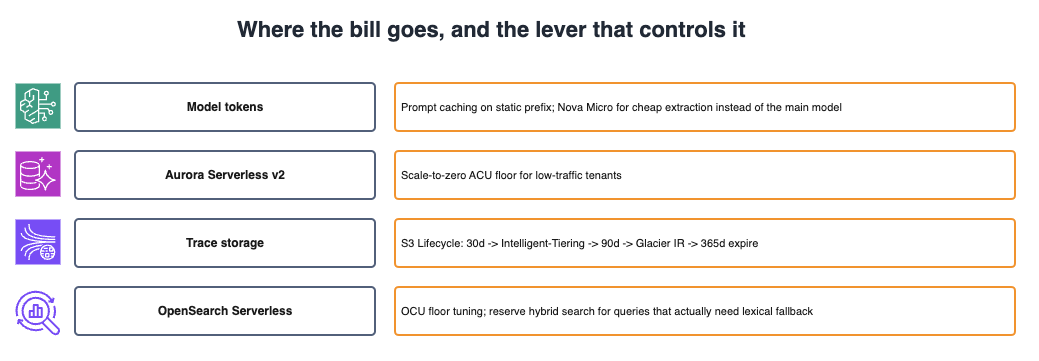
Figure 22: Cost breakdown for a typical memory system at 10k turns/day. Bedrock tokens dominate — prompt caching is the biggest lever. Aurora and OpenSearch scale with traffic; S3 scales with retention.
Here are the most effective optimizations:
| Optimization | Impact | Implementation |
|---|---|---|
| Bedrock prompt caching | 80–90% input token cost reduction | Structure prompt with static prefix. Cache system + policy + preferences. |
| Embed at write, not read | Eliminates per-query embedding cost | Compute embedding once during promotion, store in Aurora. |
| Use Nova Micro for extraction | 5–10× cheaper than Sonnet | Extract facts with Nova Micro ($0.15/MTok). Use Sonnet only for user-facing inference. |
| ElastiCache in front of DynamoDB | 80% reduction in DynamoDB read costs | Cache preferences in Redis with TTL 3600s. DynamoDB fallback on miss. |
| Aurora Serverless v2 scaling | Pay only for active ACUs | Set min=0.5, max=8 ACU. Scales to zero during idle periods. |
| S3 Lifecycle: 30d → Glacier | 90% reduction in trace log storage cost | S3 Lifecycle policy: 30d Standard → 90d Intelligent Tiering → 365d Glacier IR → expire. |
| Top-K cutoff | Reduces prompt size by 30–40% | Retrieve top-20 facts, filter by fused_score >= 0.4, return top-5. |
Cost breakdown for 10k turns/day
Component                      Daily cost    Monthly cost
────────────────────────────────────────────────────────────
Bedrock (Sonnet, cached)       $15           $450
Bedrock (Nova Micro extract)   $3            $90
Aurora Serverless v2 (2 ACU)   $4            $120
DynamoDB (on-demand)           $2            $60
ElastiCache Redis (t4g.small)  $1            $30
OpenSearch Serverless (4 OCU)  $10           $300
Kinesis + S3 (trace logs)      $2            $60
────────────────────────────────────────────────────────────
Total                          $37           $1,110

Per-turn cost: $0.0037
25. Memory in multi-agent scenarios
When you have multiple agents operating on behalf of the same user, memory becomes a shared resource. The challenge is deciding what each agent can see: should Agent B see facts that Agent A promoted? Should agents be able to hand off working context to each other? The diagram below shows three patterns for multi-agent memory coordination.
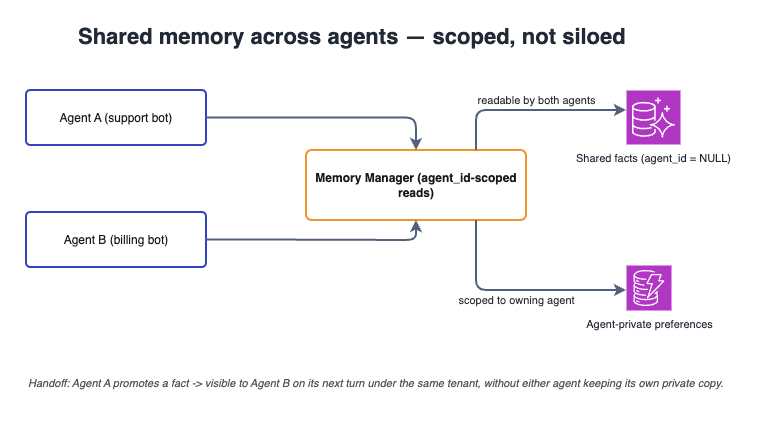
Figure 23: Multi-agent memory patterns. Shared memory for non-conflicting agents. Agent-scoped for private working memory. Coordinated handoff for explicit context transfer.
Here are the three main patterns:
1. Shared memory — all agents read from the same store
Default mode. All agents scoped to the same (tenant_id, user_id) see the same facts and preferences. Works well when agents are specialised (one handles scheduling, one handles billing) but don't conflict.
Python — Shared memory access:

# Agent A (scheduling) promotes a fact
memory.promote(
    FactCandidate(
        content="User prefers meetings after 2pm",
        subject="user:preferences",
        predicate="scheduling",
        confidence=0.9
    ),
    tenant_id="tenant-abc",
    user_id="user-123",
    agent_id="agent-scheduling"
)

# Agent B (email) retrieves the same fact
facts = memory.retrieve(
    query="What are the user's scheduling preferences?",
    tenant_id="tenant-abc",
    user_id="user-123",
    agent_id="agent-email"  # different agent, same user
)
# Result: sees the fact promoted by Agent A
2. Agent-scoped memory — each agent has private working memory
Add agent_id to the scope. Facts promoted by Agent A are only visible to Agent A unless explicitly shared.
SQL — Agent-scoped retrieval:

SELECT * FROM fact_memory
 WHERE tenant_id = :tenant_id
   AND user_id   = :user_id
   AND (agent_id IS NULL OR agent_id = :agent_id)  -- agent-scoped OR shared
   AND status    = 'active'
 ORDER BY embedding <=> :query_embedding
 LIMIT 5;
3. Coordinated memory with handoff
Agent A completes a task and explicitly hands off working memory to Agent B. Implemented as an episodic memory record with metadata.handoff_to = "agent-B".
Python — Memory handoff between agents:

# Agent A completes task and hands off
memory.promote(
    EpisodeCandidate(
        task="Drafted proposal for Acme Corp",
        outcome="Proposal saved to S3, awaiting approval",
        reusable_pattern="proposal_generation",
        metadata={
            "handoff_to": "agent-approval",
            "context": {
                "s3_key": "proposals/acme-2026-06.pdf",
                "amount_eur": 50000
            }
        }
    ),
    tenant_id="tenant-abc",
    user_id="user-123",
    agent_id="agent-drafter"
)

# Agent B retrieves handoff episode
episodes = memory.retrieve_episodes(
    query="pending approvals",
    tenant_id="tenant-abc",
    user_id="user-123",
    agent_id="agent-approval",
    filter_metadata={"handoff_to": "agent-approval"}
)
26. Evaluating the memory system
Evaluation is harder for memory systems than for RAG because the system's behaviour evolves over time as memory accumulates. Standard offline metrics (recall@K, MRR) are necessary but not sufficient. You also need to test promotion precision, scope isolation, supersession correctness, and replay fidelity.
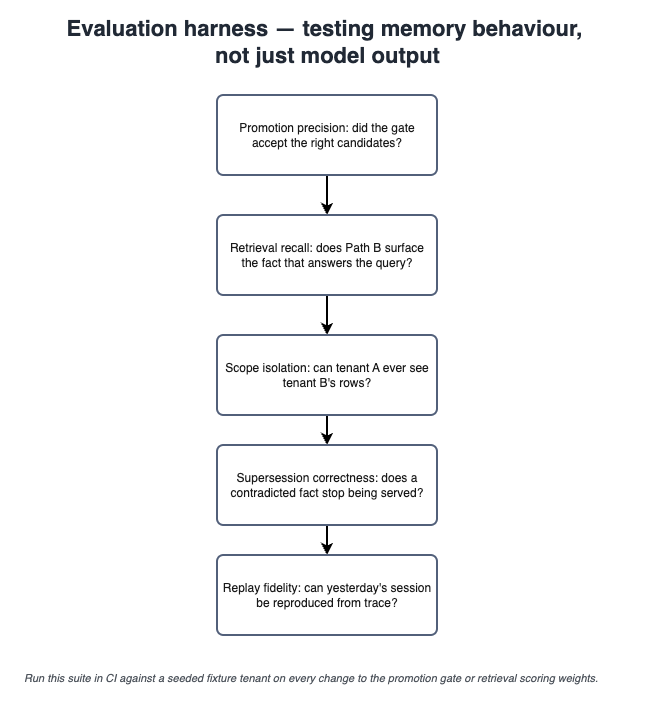
Figure 24: Evaluation harness for memory systems. Offline metrics measure retrieval quality. Online metrics measure production behaviour. Invariant tests verify scope isolation and supersession.
Here's the complete evaluation framework:
Offline metrics
| Metric | What it measures | How to compute |
|---|---|---|
| Recall@5 | % of relevant facts in top-5 results | Human-labeled ground truth on 100 queries |
| MRR (Mean Reciprocal Rank) | Rank of first relevant result | 1/rank_of_first_relevant_fact, averaged |
| Precision@K | % of retrieved facts that are relevant | relevant_in_topK / K |
| Gate acceptance rate | % of candidates promoted to durable memory | promoted / (promoted + rejected) |
| Dedup hit rate | % of promotions that hit existing fact | reconfirmed / total_promotions |
Online evaluation — what actually matters
Python — Evaluation tests:

import pytest
from memory_manager import MemoryManager

@pytest.mark.asyncio
async def test_continuity_across_sessions():
    """Agent should remember facts from previous session"""
    manager = MemoryManager(...)

    # Session 1: User states preference
    await manager.promote(
        FactCandidate(content="I prefer JSON output", confidence=0.95),
        tenant_id="test-tenant", user_id="test-user", run_id="run-1"
    )

    # Session 2: 24 hours later
    results = await manager.retrieve(
        query="How should I format the response?",
        tenant_id="test-tenant", user_id="test-user"
    )

    assert any("JSON" in f.content for f in results.facts)

@pytest.mark.asyncio
async def test_policy_always_retrieved():
    """Policy memory must be retrieved exhaustively, not ranked"""
    manager = MemoryManager(...)

    # Insert 3 policies
    policies = ["refund_threshold", "data_residency", "tone_guardrail"]
    for p in policies:
        await manager.store_policy(tenant_id="test-tenant", policy_key=p, ...)

    # Retrieve with unrelated query
    results = await manager.retrieve(
        query="What is the weather?",  # unrelated query
        tenant_id="test-tenant", user_id="test-user"
    )

    # All 3 policies must be present
    assert len(results.policies) == 3

@pytest.mark.asyncio
async def test_gdpr_deletion_cascade():
    """User deletion must cascade across all stores"""
    manager = MemoryManager(...)

    # Create facts + preferences
    await manager.promote(FactCandidate(...), tenant_id="t", user_id="u", ...)
    await manager.store_preference(tenant_id="t", user_id="u", ...)

    # Delete user
    await manager.gdpr_delete_user(tenant_id="t", user_id="u")

    # Verify nothing is retrievable
    results = await manager.retrieve(query="anything", tenant_id="t", user_id="u")
    assert len(results.facts) == 0
    assert len(results.preferences) == 0
27. Production checklist
Before deploying a memory system to production, validate these operational requirements. The diagram below shows the five production-readiness gates: scope enforcement, observability, cost controls, correctness, and compliance. All five gates must pass — a failure in any one can cause data leaks, runaway costs, or incorrect behaviour.
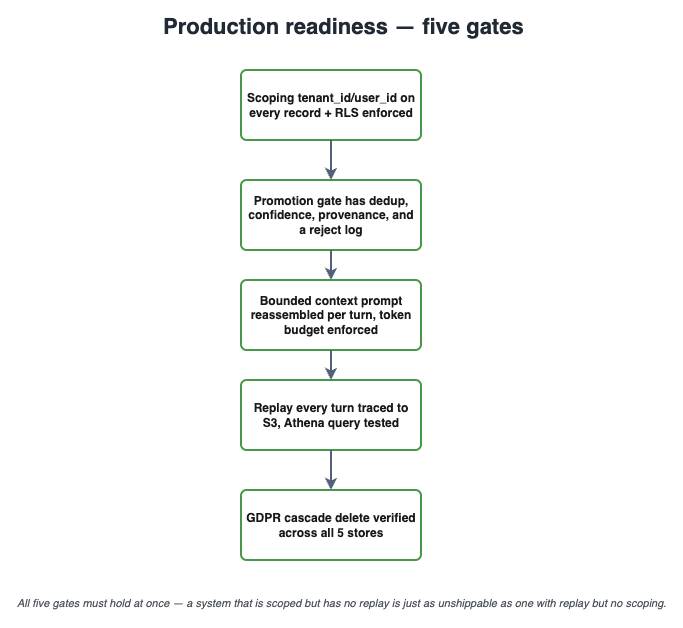
Figure 25: Production-readiness gates. All five categories must pass before shipping. The table below lists specific requirements and how to verify each one.
Validate each requirement before deploying:
| Category | Requirement | How to verify |
|---|---|---|
| Scope enforcement | Every query filters by tenant_id BEFORE ranking |
Inspect SQL execution plans |
| RLS enabled on all Aurora tables | SELECT * FROM pg_policies; |
|
| No cross-tenant data leakage in test suite | Run multi-tenant isolation tests | |
| Observability | CloudWatch metrics: CacheHitRate, GateRejectionRate | Check CloudWatch dashboard |
| X-Ray tracing on all Bedrock calls | Open X-Ray console, filter by service | |
| Trace log to S3 with Parquet format | Query with Athena | |
| Cost controls | Bedrock prompt caching enabled | Check cacheReadInputTokens > 0 in responses |
| S3 Lifecycle: 30d → Glacier | Verify S3 bucket lifecycle policy | |
| Correctness | Policy and preference never use similarity search | Code review: no ORDER BY embedding on these tables |
Promotion gate rejects confidence < 0.5 |
Check gate rejection logs | |
Supersession marks old facts as superseded_by |
Manual test: update a fact, verify old row excluded | |
| Compliance | GDPR deletion cascades across Aurora, DynamoDB, S3 | Run test_gdpr_deletion_cascade |
Provenance: every fact has source_run_id |
SQL: SELECT COUNT(*) FROM fact_memory WHERE source_run_id IS NULL; → 0 |
|
| Resilience | Cascade fallback: hybrid → vector → lexical → LIKE | Simulate Aurora downtime, verify fallback |
| Dead-letter queue for failed promotions | Check SQS DLQ for messages |
Ready for production
When all checks pass, your memory system is production-ready. You have scope enforcement, observability, cost controls, correctness guarantees, compliance tooling, and resilience to component failures. What remains is operational experience — watch the metrics, tune the gate thresholds, and iterate based on what users forget vs what they remember.
Conclusion: Models are shared. The memory system is yours.
Much of the current talk about "AI memory" is retrieval plus larger prompts with better branding. If your system only needs semantic lookup over documents, basic RAG is sufficient. If it must maintain continuity across sessions, precisely recall structured information, govern reuse across real privacy boundaries, and learn what to retain over time — you have a memory system design problem. A vector store alone does not solve it.
On AWS you have all the components natively: Aurora Serverless v2 with pgvector for hybrid retrieval and ACID transactions; DynamoDB for exact-match policy and preferences; OpenSearch Serverless for lexical recall; S3 + Kinesis for the trace log; AgentCore Memory for a managed memory API; Amazon Bedrock with prompt caching for inference. The pieces are there. The architecture connecting them is what this article describes.
Models are shared. The memory system is yours — because it reflects decisions only your team could make: what is remembered, what is forgotten, who can see it, and what that implies on the next turn.